


8th Global Council Meeting | Summary
28 October 2025, Paris and online
The Global Council for Responsible Transition Minerals held its 8th meeting on October 28, on the sidelines of the 8th edition of the Paris Peace Forum. Taking place just days before COP30 in Belém, weeks before UNEA-7 and amidst growing focus on minerals in G7 and G20 Presidencies, this meeting offered a critical window to discuss topical issues such as recent geopolitical developments related to minerals, the G7 and G20 agendas, and ongoing efforts toward an international agreement on minerals.
Update on Global Trends
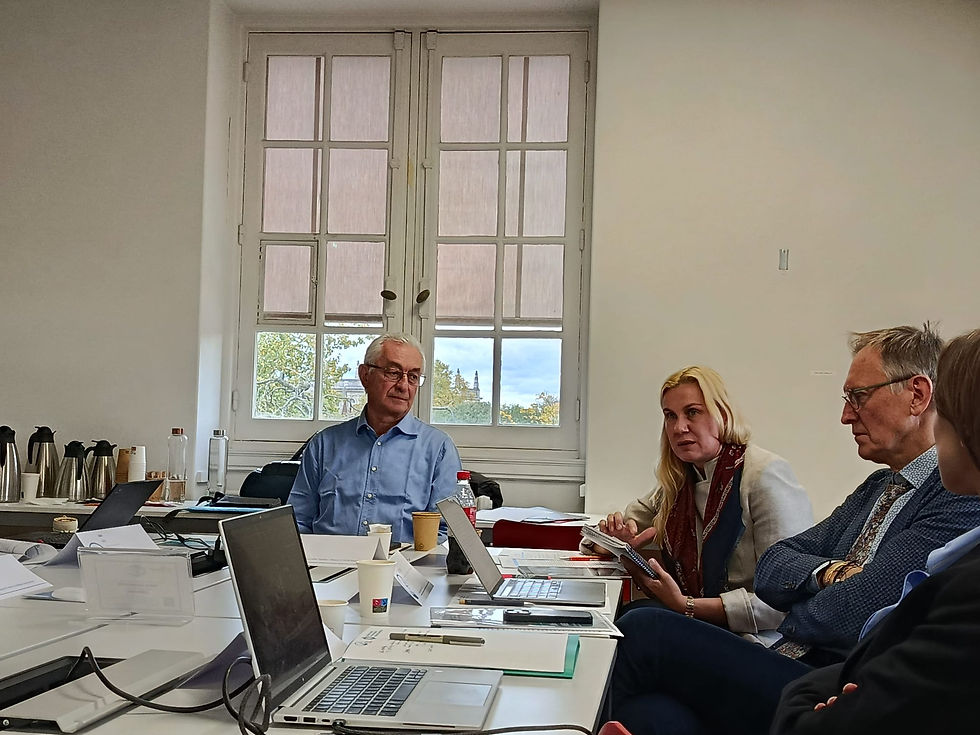
Council members and external contributors examined the shifting geopolitical landscape of the minerals sector, highlighting the persistence of supply concentration and the implications for energy security. Despite intensified global efforts to diversify sources of “critical” minerals, supply concentration remains significant, with midstream and downstream processing continuing to rely heavily on China. According to the International Energy Agency’s (IEA) Global Critical Minerals Outlook, China is the dominant refiner for 19 of 20 key transition minerals, accounting for roughly 70% of total refining capacity. This concentration is projected to continue beyond 2030, particularly across midstream and downstream stages of value chains.
Efforts by other economies to expand processing capabilities, particularly in the United States and Europe, have been constrained by high capital expenditures, elevated operating costs, and limited economies of scale. Even with strategic incentives and investment, western competitiveness remains limited compared to Chinese market.
In parallel, the growth of export controls and trade restrictions is reshaping global mineral markets. Recent export restrictions, such as on cobalt by the DRC and on rare earths by China – paused following Donald Trump and Xi Jinping meeting, are making supply diversification more complex in practice, with growing scope, increasingly including battery and processing technologies.
While diversification strategies remain central to States’s security strategies, the discussion emphasized the importance of investing in mining projects, technological innovation, processing and recycling infrastructures to foster resilience and cooperative approaches. Despite policy momentum, private capital remains largely absent from mining investment and concentrated to generalist investors. Participants argued that financial and innovative de-risking tools – that go beyond offtake guarantees and price support mechanisms towards equity investments - are necessary to enhance private-sector participation, and thus, making mining projects bankable and viable. A shift towards equity investments is already taking place under the Trump Administration: the US government has partnered with investment firms Orion Resource Partners and Abu Dhabi Developmental Holding Company (ADQ) to establish a new $1.2 billion fund to invest in critical minerals, and International Finance Cooperation (IFC) and Appian have launched a new US $1 billion partnership to accelerate the responsible development of critical minerals, metals and mining related projects in Africa and Latin America. While some stakeholders caution that public equity stakes can also be interpreted as a risk signal for unsupported projects and that equity should complement, rather than replace, other tools (predictable offtake, streamlined permitting, enabling infrastructure, and demand-side measures), participants recalled the need to align mineral finance with broader green transition policy.
On the other hand, the European Commission approached de‑risking and supply reliability in critical minerals by emphasizing market predictability, signaling long‑term demand rather than intervening directly in price stability. For example, when Australian nickel producers faced closures amid low prices and overcapacity in Indonesia, the EU sought to reassure them it would remain a reliable buyer. Lacking direct financial tools to stabilize prices, the European Commission instead committed to visibility of future demand by setting clear targets under the Critical Raw Materials Act (CRMA), including the requirement that no more than 65 % of any mineral supply may originate from a single third‑country source.
Amidst increased geopolitical tensions and fragmentation, the Global Council underscored the need to strengthen global collaboration, including with actors such as China. Managing global risks in the mineral and energy sectors requires shared responsibility, both for major producers and consumers. Economic decoupling is neither realistic nor desirable: decades of global interdependence cannot be dismantled without severe economic, social and environmental disruption. Instead, nations should look for practical, cooperative ways to de-risk transition mineral supply chains while advancing urgent climate and biodiversity goals.
All actors must work collaboratively across both the Global South and the Global North, East and West to manage the environmental and economic impacts of its activities. Prioritizing narrow national security or protectionist approaches over collective action would jeopardize global stability and environmental and climate goals.
2. The Concept of Standards-Based Market in the G7 Critical Minerals Action Plan

In June 2025, the leaders of the G7 adopted a Critical Minerals Action Plan at their summit in Kananaskis, Canada – followed by the adoption of a Roadmap to promote Standards-based Markets for Critical Minerals on October 31st. Building on the work of the Japanese and Italian presidencies, and endorsed by Australia, India, and the Republic of Korea, the Plan underlines that critical minerals are the “building blocks of digital and energy-secure economies of the future.” It sets out three priorities: the creation of standards-based markets, the mobilization of capital and partnerships, and the promotion of innovation.
Over the first half of September, the Secretariat held consultations among the Global Council’s group of Special Advisors to gather diverse perspectives from private sector actors, civil society, and international organizations. In their last meeting, on September 11th, the Global Council debated on their position, based on the outcomes of the consultations (See 7th Meeting of the Global Council).
During the 8th Meeting, members of the Global Council adopted the Position paper on the G7 Critical Minerals Action Plan’s Concept of “Standards-based markets”. The adopted paper is available here. The Secretariat added that this position paper could serve as a basis for informing discussions under the upcoming French G7 Presidency. The Global Council, as a global and independent actor, could also promote this position in broader international fora, such as among G20 and BRICS+ countries.
3. G20 Developments: Towards Greater Added Value
South Africa’s G20 Presidency - the only African country in the G20 - has placed a strong focus on critical minerals, building on the last three years’ presidencies, held by Brazil (2024), India (2023) and Indonesia (2022), while the United States will take over in 2026. Reflecting one of its core priorities “Harnessing critical minerals for inclusive growth and sustainable development”, an ad hoc task force on “Inclusive Economic Growth, Industrialisation, Employment and Reduced Inequality” is advancing the establishment of a governance framework for critical minerals, aimed at promoting secure, transparent and sustainable value chains.
The T20 - think tank engagement group gathering research institutes and universities to provide policy recommendations to G20 leaders – has fed into this work through its Task Force 5 “Accelerating Climate Action and the Just Energy Transition”, co-Chaired by Céline Kauffmann (IDDRI), Maiara Folly (Plataforma CIPÓ) and Gaylor Montmasson-Clair (Southern Transitions). The Task Force engaged in four areas: i) Promoting Sustainable and Equitable Critical Mineral Value Chains; ii) Scaling Adaptation Finance; iii) Supporting Inclusive, Just Energy Transitions, and iv) Biodiversity-Climate-Development Nexus. As core priorities, the Task Force recommended that:
“The G20 Critical Minerals Governance Framework should promote value addition and fair benefit-sharing in critical mineral value chains for equitable green industrialisation, making partnership agreements related to critical minerals publicly available, endorsing a credible global mining standard and capacitating producer countries for implementation and monitoring, including consideration of social and environmental monitoring and safeguards.”
This recommendation is built on the following pillars: mutually beneficial, inclusive partnerships - bridging the gap between long-term security of supply and local, equitable development; green industrialization and development policies; diversification objectives that must be compatible with climate action and biodiversity protection; and local development.
To be effective, the Framework must be backed by concrete supporting measures, including strengthening transparency in partnerships and supply chains (public disclosure of partnership agreements, establishment of robust traceability mechanisms), capacity building for producer countries to capture greater value from their mineral endowments (fit-for-purpose technologies, skills, and finance). Another central pillar is endorsing a credible global mining standard by bridging the current fragmentation of standards - to ensure consistent expectations around good governance, decent working conditions, human rights, and environmental stewardship, in line with existing international norms. Finally, the importance of systematically integrating social and environmental impact assessments, safeguards, and ongoing monitoring throughout project lifecycles has been deemed necessary.
However, discussions highlighted that the real challenge lies in moving from ideas to practical implementation. Progress requires strong domestic leadership and coherent national policies. Moreover, expectations of a “perfect” market overlook the reality that States will always act to protect their own interests, as demonstrated by China’s export restrictions or the EU’s carbon border adjustment mechanism.
It was indicated that the European Union’s recent approach to minerals reflects this balance, by emphasizing just transition beyond European countries. While securing access to critical raw materials is a strategic priority given the growing demand and supply concentration risks, the EU aims to ensure that its actions also promote fairness, shared prosperity, and sustainable development. The recently-launched “RESourceEU” plan, modeled on the earlier REPowerEU initiative, seeks to reduce Europe’s vulnerability by diversifying supply while building equitable partnerships with countries like Ukraine, Australia, Canada, Kazakhstan, Uzbekistan, Chile and Greenland – in addition to existing partnerships with Namibia, Zambia, the DRC, Chile, Argentina, and others.
The current situation was described as a “battle of narratives” among different discussions, including those held under G7 and G20 leaderships, the former being perceived as framing minerals as a security concern while the second as promoting co-benefits.
While concrete and country-specific tools such as EU-South Africa Clean, Trade and Investments Partnerships (CTIPs) are being deployed, there is a clear need to rethink narratives to avoid a one-size-fits-all “European policy towards Africa”, which in a continent of 54 sovereign countries may appear inadequate. Additionally, EU’s shortage of minerals not only stems from its lack of resources but from its resistance to mining (“not in my backyard”), weakening it credibility in engaging with the Global South.
Finally, value creation strategies must be tested against uncertain demand and supply dynamics. Contrary to the widespread idea of a “mineral boom”, some analyses predict a possible 30-year period of low demand (Martin Lynch), having consequences on actual benefits. Another major development may emerge in light of the growing attention on Deep-Sea Mining. The launch of deep-sea mining of polymetallic nodules containing cobalt, copper, nickel, and manganese by the US-licensed company The Metals Company – could potentially flood the market and cause prices to fall, impacting producers like the DRC – tough its long-term economic viability remains uncertain. Policymakers should plan for future scenarios, taking into account technological and supply developments which could rapidly alter market dynamics and undermine value for mineral-rich countries.
4. Update on an integrated minerals governance: International Minerals and Metals Agency, Data Hub and International Agreement on Minerals
The Call for An International Minerals Agency for Data Disclosure
In its 2024 Interim report, the Global Council for Responsible Transition Minerals recommended the “creation of an interoperable mineral data repository to consolidate existing information on mineral endowments, regulations, trade flows, and ESG impacts” to support global policymaking with well-grounded insights. Since the Global Council’s recommendation, the idea has grained traction across different institutions. In a Special Advisor meeting, held in May 2025, experts of the mineral sector agreed that “While the IEA and its 32 Member States have stepped into the role of a mineral agency to overcome this critical gap, the need remains for a standalone specialized agency which could address the needs of developing and emerging economies and provide a global and regional platform for dialogues and advocacy across cross-cutting issues.”
Several major organizations beyond the Global Council have called for greater transparency, data harmonization, and disclosure of social and environmental impacts. In its reports Global Resource Outlook 2024 and Financing the Responsible Supply of Energy Transition Minerals, the United Nations Environmental Programme (UNEP)’s International Resource Panel (IRP) has consistently highlighted the need for improved global governance of minerals and materials. Other organizations include the Intergovernmental Forum on Mining (IGF), UN Secretary-General’s Panel on Critical Energy Transition Minerals, OECD, International Monetary Fund (IMF), IRENA, and International Chamber of Commerce (ICC).
Earlier this year, the IRP launched a Call to Action for 21st Century Global Materials Stewardship, identifying four key priorities for better materials stewardship:
Better orientation, through science-based material use targets and related guidance.
Better measurement, through indicators that measure the ability of systems for housing, mobility, food and energy to meet people’s needs in material-efficient ways.
Better economic incentives, through policy and fiscal reforms that internalize environmental and social costs of material extraction in material prices and phase out harmful subsidies.
Better transparency and coordination, through access to consolidated data on material flows and impacts – provided by an International Materials Agency that is hosted in a resource-rich country.
The call for an International Minerals and Metals Agency (IMMA or IMA), as conceptualized by the IRP, was specifically echoed by different actors. The Sustainable Business Coalition’s COP30 Circular Economy and Materials Working Group recently recommended creating an “International Materials Agency to help governments improve transparency and data collection aligned with international standards while offering guidance to market participants” and the Global Investor Commission on Mining 2030’s last report recommended the creation of a similar agency.
At the same time, a coalition of organizations is emerging to support the creation of a Global Materials Data Hub, envisioned as a central platform for data transparency and coordination, coordinated by the International Chamber of Commerce (ICC) and Systemiq. The project was discussed at the 2025 Paris Peace Forum, in a Roundtable held on October 30th, which brought together representatives from international organizations, NGOs, governmental surveys, companies and other actors to discuss the scope, use cases of such a platform, as well as priorities and potential constraints.
While Global Council discussion highlighted broad support for the initiative, aligning with prior Global Council’s commitments for such a body, concerns were raised about the challenge of data transparency and digitalization accessible to all, including to local communities and civil society on the ground. While presented as “open-sourced”, the accessibility of such a platform could be undermined for the sake of company’s competitiveness or privacy – thus creating an imbalance where companies can trace and control information about mineral origins and trade flows, and affected communities and consumers cannot monitor revenues royalties, export quotas, or social and environmental impacts.
Concerns were also raised about the inadequacy of public policies with transparency implications that such an Agency would imply. For example, while the EU promotes digitalization and traceability of mineral supply chains, including through blockchain systems under its strategic partnerships, these systems often remain closed to communities and civil society watchdogs in producer countries. Moreover, it was indicated that corporate accountability directives are being weakened, further diluting the scope of reporting obligations, and that Global Gateway investments – such as the €180 million announcement for DRC’s sustainable growth and resource management – lack transparency regarding how and where funds are allocated. Participants stressed that to effectively complement de-risking efforts, the EU must guarantee open access to data, strengthen consistency across its initiatives, and ensure public traceability of projects and revenues.
Additionally, such an agency could only effectively address the issue of heightened demand for resources when coupled with demand-side measures and public education. Informed consumer behavior remains key to avoid disconnection between overconsumption patterns and sustainability goals. The important role of recycling was highlighted as well as its limitations in meeting projected mineral demand. An example of public education has been the use of digital and AI-driven tools to enhance transparency and consumer engagement. For instance, new applications now allow users to identify the embodied carbon footprint of vehicles by simply scanning them, making visible the hidden environmental costs of car manufacturing. Such initiatives have proven effective in mobilizing public awareness and corporate accountability, as consumers began pressuring automakers to reduce emissions.
Towards an International Agreement on Minerals Resources
Akin to the concept of an International Minerals Agency, the 2024 Global Council Interim report called for the “establishment of a working group to draw a roadmap towards an International Agreement on the Management of Resources. This would serve to foster international collaboration on the access and benefit-sharing of these essential resources”.
Recent efforts in this direction have been undertaken by other actors such as a draft Resolution submitted by Colombia and Oman for the upcoming United Nations Environmental Assembly (UNEA-7) aiming at establishing a working group to explore options for an environmentally sound management of resources.
Regional initiatives have also emerged, such as the proposal by Democratic Republic of the Congo on October 22, for an Organization of Strategic Minerals Producing and Exporting Countries, modeled on OPEC.


